Der Aufbau der Klinge ist ein wichtiges Kriterium für den Preis einer Samuraischwert Klinge. Je mehr verschiedene Härten zusammen geschmiedet werden, desto aufwändiger ist die Herstellung.
Aber bringt ein komplizierter Aufbau Vorteile oder ist er nur unnötig teuer? Dieser Frage werden wir in diesem Beitrag nachgehen.
Wozu gibt es überhaupt einen bestimmten Klingenaufbau bei der Samuraischwert Klinge?
Eine berechtigte Frage, denn es würde ja reichen eine Samuraischwert Klinge immer mit dem einfachsten Klingenaufbau (Maru) zu produzieren. Doch das Verwenden von Stahl mit unterschiedlichen Härten war früher zwingend nötig:
Tamahagane Stahl mit einem hohem Kohlenstoff-Anteil ist sehr hart, aber auch spröde. Bei historischen Nihonto Klingen war es wichtig unterschiedliche Härten zu benutzen. Eine Klinge, die nur aus hartem Tamahagane besteht, würde sehr schnell brechen. Besonders wenn sie auf harte Rüstungen geschlagen wird.
Im Kampf hatten Klingenkonstrutionen wie Kobuse den Vorteil, dass das Schwert nicht gleich bricht, wenn die harte Schicht beschädigt wurde, sondern das Schwert noch durch den weichen Kern „zusammengehalten“ wurde.
Außerdem war es mit solchen Klingen möglich mit dem weichen Rücken zu parieren ohne dass die Schicht an der Schneide Schaden nimmt.
Ein positiver Nebeneffekt von Klingenkonstruktionen ist die Verwendung von Stahl in unterschiedlicher Qualität. Denn die japanische Geschichte war auch vom Mangel an qualitativ gutem Stahl geprägt. Mit speziellen Klingenkonstruktionen konnte für die weichen Bestandteile weniger hochwertiges Metall verwendet und das teure, hochwertige Material gezielt an der richtigen Stelle eingesetzt werden.
Diese Vorteile gelten für Klingen aus Tamahagane Stahl und nicht für Klingen aus modernem Industriestahl! Warum das so ist wird weiter unten erläutert.
Beispiele für einen komplexen Klingenaufbau beim Samuraischwert
Wir zeigen hier häufig verwendete Aufbauarten. Es gibt sehr viele Möglichkeiten für den Aufbau einer Klinge, aber das Prinzip sollte durch diese Beispiele klar werden:
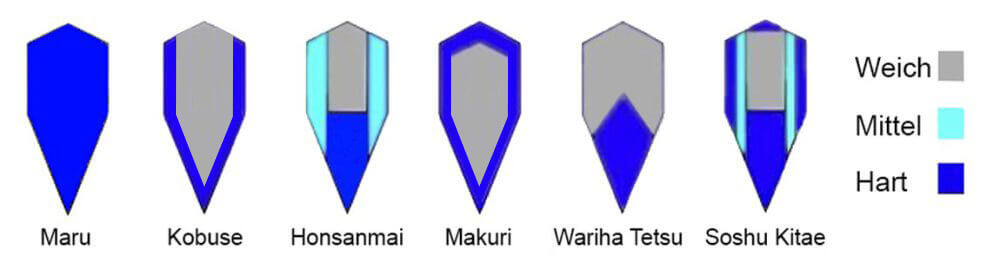
Maru
Maru ist der einfachste Klingenaufbau für eine Samuraischwert Klinge. Es ist der sinnvollste und kostengünstigste Aufbau für Klingen aus modernem Industriestahl.
Kobuse
Die Kobuse Klingenkonstruktion hat zwei verschiedene Härtegrade. Eine äußere harte Stahlschicht und ein weicher Kern. Sie ist der Standard-Aufbau für Schwerter aus Tamahagane Stahl.
Honsanmai
Die Honsanmai Klingenart ist eine sehr gebräuchlichste Konstruktionen für Klingen. Sie hat 3 verschiedene Härtegrade. Das Klingeninnere ist weich, die Klingenschneide hart und die äußere Schicht hat im Vergleich zu den anderen beiden einen mittleren Härtegrad. Bei diesem Aufbau sollte berücksichtigt werden, dass die mittel-harte Außenschicht bei Schnitttests relativ schnell verkratzen kann.
Makuri
Die Makuri Klingenart ist eine relativ einfache Konstruktion, da hierbei ein Weicheisenkern komplett von einem harten Stahlmantel umgeben ist.
Wariha Tetsu
Die Wariha Tetsu Klingenart ist eine Konstruktion die aus zwei Stahlhärtegraden besteht. Die Schneide der Klinge ist hart, wobei der Rest der Klinge aus einem weicheren Metall besteht.
Soshu Kitae
Die Soshu-Kitae Klingenart ist eine der aufwändigeren Konstruktionen mit mehreren Stahl-Härtegraden.
Warum haben sich so viele Klingenkonstruktionen entwickelt und warum gibt es sie heute noch?
Die Klingenkonstruktionen brachten früher einige Vorteile mit sich, wie weiter oben beschrieben. Die alten Schwertschulen schufen deshalb immer komplexere Klingenstrukturen, um die Eigenschaften der alten Schwerter noch zu verbessern. Klingenkonstruktionen waren teilweise sogar das Erkennungszeichen einzelner Schwertschulen.
Heutzutage gilt in Japan das Gesetz, das Schwerter nur nach alten Tradiotionen gefertigt werden dürfen. Es muss also Stahl wie Tamahagane Stahl benutzt werden und dieser braucht einen komplexen Klingenaufbau für ein brauchbares Schwert. Deshalb werden Schwerter aus Tamahagane meistens in Kobuse-Form geschmiedet und die alten Klingenkonstruktionen bestehen bei den in Japan geschmiedeten Shinsakuto continue.
Bei Klingen aus modernem Industriestahl bringt ein komplexer Klingeaufbau meistens keine Vorteile und verursacht nur unnötige Kosten.
Was ist der Unterschied zwischen verschiedenen Stahl bei Damaszener Stahl und den Klingenkonstruktionen
Eine Frage, die häufig von Kunden gestellt wird, ist was der Unterschied zwischen einer Klinge aus Damaszener Stahl und einer Klinge mit einem bestimmten Klingenaufbau ist.
Bei Damaszenerstahl wird zuerst ein Paket aus unterschiedlichen Stahlsorten gefaltet, weiter gefaltet, … und am Ende wird dieses Paket in die Länge ausgeschmiedet.
Schwert mit bestimmtem Aufbau der Klinge bestehen hingegen häufig aus nur einer Stahlsorte mit unterschiedlichem Kohlenstoffgehalt. Die einzelnen Elemente werden nicht durch Falten miteinander kombiniert, sondern „nur“ verbunden und dann zusammen ausgeschmiedet, um die endgültige Länge des Schwertes zu erreichen.
Klingenaufbau bei mittelpreisigen Schwertern
Mittelpreisige Schwerter (alles bis ca. 2000 Euro) sind meist aus industriellem Normstahl gefertigt. Eine kurze Beispielliste von industriell gefertigten Stahlsorten finden Sie in diesem Beitrag über Stahlsorten.
Bei diesen Schwertern wird von einigen Verkäufern suggeriert, dass eine Klinge mit komplizierter Klingenkonstruktion bessere Eigenschaften hätte, als Klingen mit einfachem Aufbau. Genau das Gegenteil ist aber meistens der Fall!
Der Stahl von heute ist wesentlich flexibler als die alten Stahlsorten von damals.
Es besteht nur ein geringeres Risiko, dass eine echte Maru-Klinge aus modernem Stahl bricht. Außer man schlägt mit weichem Stahl auf zu harte Ziele, also zum Beispiel mit 1045 Kohlenstoffstahl auf Metall.
Bei modernen Schwertern aus Industriestahl ist eine aufwändige Klingenkonstruktion in der Regel unnötig. Vorausgesetzt es wird der richtige Stahl benutzt.
Wenn ein Schwert aus Industriestahl für Schnitttests verwendet werden soll, empfehlen wir den Aufbau Maru in Kombination mit einem geeigneten Stahl, beispielsweise 1060 Kohlenstoffstahl oder Federstahl! Moderner Stahl bricht auf Grund seiner Bestandteile nicht so schnell. Wenn noch zusätzlich weicher Stahl mit verarbeitet wird, erhöht das vor allem die Gefahr, dass sich die Klinge bei Schnitttests verbiegt. Außerdem gilt ähnlich wie bei der Anzahl der Faltungen, dass die aufwändigere Konstruktion bei unsauberer Verarbeitung Risiken für die Qualität der Klinge erheblich verschlechtert.
Lassen Sie sich also nicht mit Falschinformationen unnötig Geld aus der Tasche ziehen.
Schwerter zu angemessenen Preisen finden Sie in unserem Shop.
Video über das Thema:

 German
  English
  French